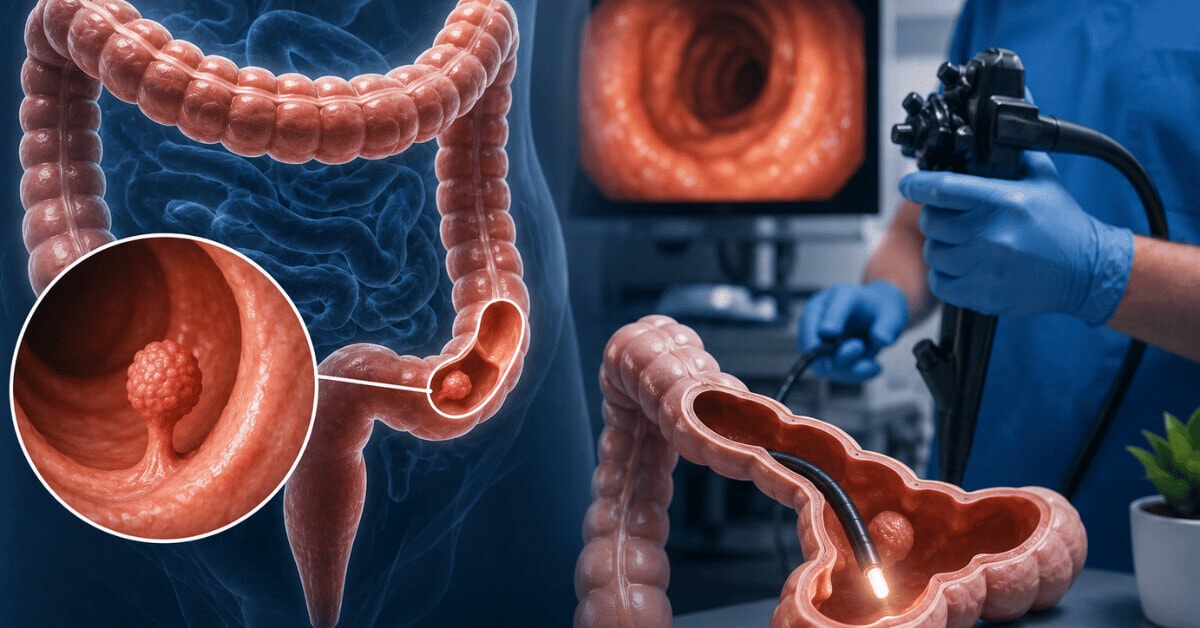


Colorectal cancer is cancer that starts in the colon or rectum. It often begins as small growths called colon polyps. Some polyps can slowly turn into cancer over time if they are not found and removed.
Many people with early colorectal cancer have no symptoms. When symptoms do appear, they may include rectal bleeding, blood in the stool, bowel habit changes, abdominal pain, unexplained weight loss, fatigue, or iron deficiency anemia.
Understanding colorectal cancer symptoms is important because early evaluation can lead to earlier diagnosis and more effective care. Colorectal cancer treatment may include colonoscopy, surgery, chemotherapy, radiation therapy, targeted therapy, immunotherapy, or a combination of treatments depending on the cancer location and stage.
This guide explains the common symptoms, causes, risk factors, diagnosis, screening, and treatment options for colorectal cancer..
What is Colorectal Cancer?
Colorectal cancer refers to cancer that develops within the colon or the rectum. These two parts are the final parts of the digestive tract. They pull water out of waste and get the body ready to expel it.
Almost all cases start with polyps, or additional tissue that develops on the inner wall of the colon or rectum. Plenty of polyps stay harmless forever. But a number slowly changes into cancer if left alone.
When cancer sets in, it spreads further through the layers of the colon. It then spreads to surrounding regions, lymph nodes, or distant places such as the liver and lungs. The doctors classify the disease into stages, starting with Stage 0 (only abnormal cells in the lining) and progressing to Stage IV (spread to other parts of the body). Understanding this development pattern reveals precisely the importance of routine checks and timely diagnoses.
Symptoms of Colorectal Cancer
Colorectal cancer symptoms can be mild at first. Some people have no symptoms in the early stage. That is why screening is important, especially for adults age 45 and older.
Common colorectal cancer symptoms may include:
- Rectal bleeding
- Blood in or on the stool
- A change in bowel habits
- Ongoing diarrhea or constipation
- Narrow stools
- Feeling like the bowel does not empty completely
- Abdominal pain, cramps, gas, or bloating
- Unexplained weight loss
- Fatigue or weakness
- Iron deficiency anemia
Rectal bleeding should not be assumed to be “just hemorrhoids.” Hemorrhoids are common, but bleeding can also come from colon polyps, colon cancer, rectal cancer, inflammatory bowel disease, or other conditions. If symptoms are new, worsening, recurring, or lasting more than a few weeks, schedule a medical evaluation. The persistent abdominal pain indicates the potential for serious gut issues, including colorectal cancer.
Unexplained Weight Loss: The loss of weight without adjusting the food intake or the activity level is more likely to signal a larger issue, such as cancer.
Weakness and Fatigue: Feeling wiped out happens when ongoing internal bleeding causes anemia from steady blood loss in the gut.
Iron Deficiency Anemia: Long-term bleeding from tumors in the colon drains iron stores and brings on anemia.
When Should You See a Doctor for Colorectal Cancer Symptoms?
You should schedule a medical evaluation if you have rectal bleeding, blood in the stool, persistent bowel habit changes, unexplained abdominal pain, unexplained weight loss, fatigue, or anemia.
You should also seek care if you have a personal history of colon polyps, a family history of colon cancer or rectal cancer, Crohn’s disease, ulcerative colitis, a positive stool test, or new bowel symptoms after age 45.
Early evaluation matters. Colorectal cancer treatment is often more effective when cancer is found at an earlier stage. Always have a check-up and screening with a doctor whenever these symptoms continue or worsen.

Causes of Colorectal Cancer
Colorectal cancer starts when cells within the colon or the rectum accumulate genetic alterations. The changes disrupt the normal growth and division of the cell, thereby allowing defective cells to accumulate and form tumors. There are enough health problems, genetic patterns, and routines that contribute to its triggering.
Common causes and contributing factors include:
- Colon cell changes in genes that trigger wild growth and tumor initiation.
- Colon polyps, particularly adenomatous polyps, which become cancerous over the years unless removed.
- The close family members who have colorectal cancer or polyps increase the inherited risks.
- Hereditary conditions such as Lynch syndrome and familial adenomatous polyposis (FAP).
- Harm to the colon lining caused by long-term gut inflammation due to Crohn’s disease or ulcerative colitis.
- Consuming a high amount of processed meat or red meat and low amounts of fiber, fruits, and vegetables.
- Such habits as carrying extra weight, smoking, remaining inactive, and excessive alcohol intake.
- Being older, as the majority of the diagnoses happen after 50.
Risk Factors for Colorectal Cancer
The probability of developing colorectal cancer is increased by a number of personal, family-related, and lifestyle factors.
Age: Chances climb sharply once someone hits 45.
Family History: Anyone having parents, brothers, or children with colorectal cancer or polyps are at increased risk.
Colon Polyps: Multiple polyps mean higher odds of one turning cancerous.
Inflammatory Bowel Diseases: Crohn’s disease and ulcerative colitis both raise cancer chances over time.
Lifestyle Factors: Daily choices tied to higher risk include:
- Heavy intake of processed or red meat
- Low fiber from food
- Little to no exercise
- Smoking
- Too much alcohol
- Extra body weight
Colorectal Cancer Screening
Colorectal cancer screening helps find cancer early, often before symptoms begin. Screening can also help find and remove certain colon polyps before they become cancer.
Most adults should begin colorectal cancer screening at age 45. Some people may need screening earlier if they have a family history of colorectal cancer, a personal history of colon polyps, inflammatory bowel disease, Lynch syndrome, familial adenomatous polyposis, or other high-risk conditions.
Screening options may include stool-based tests, colonoscopy, and other tests depending on risk level and medical history. If a stool test is positive, a colonoscopy is usually needed to evaluate the colon and rectum.
Stages of Colorectal Cancer
Doctors use stages to describe how far colorectal cancer has gone.
- Stage 0: Only abnormal cells sit in the innermost colon layer.
- Stage I: Cancer stays inside the colon wall and nowhere else.
- Stage II: It digs deeper into the wall but skips to lymph nodes.
- Stage III: Nearby lymph nodes now hold cancer.
- Stage IV: Cancer can reach far organs like the liver or lungs.
Treatment Options for Colorectal Cancer
Colorectal cancer treatment depends on the cancer location, stage, biopsy results, imaging findings, lymph node involvement, and the patient’s overall health.
Treatment may include surgery, chemotherapy, radiation therapy, targeted therapy, immunotherapy, or a combination of treatments. These treatments may be used alone or together depending on the stage and type of colorectal cancer.
Colon Cancer Treatment
For many patients with colon cancer, surgery is the main treatment when the cancer has not spread to distant organs. Colon cancer surgery usually removes the section of colon containing the cancer, along with nearby lymph nodes. This operation is called a colectomy.
Chemotherapy may be recommended after surgery depending on the stage, lymph node involvement, tumor features, and risk of recurrence.
When appropriate, colon cancer surgery may be performed using minimally invasive techniques such as laparoscopic surgery or robotic surgery. These approaches may help selected patients have smaller incisions, less pain, lower wound infection risk, shorter hospital stays, and faster recovery.
Rectal Cancer Treatment
Rectal cancer treatment may be different from colon cancer treatment because the rectum is located deep in the pelvis and is close to important nerves and muscles that affect bowel control.
Treatment for rectal cancer may include chemotherapy, radiation therapy, immunotherapy, targeted therapy, and surgery. In some cases, chemotherapy and radiation may be used before surgery to shrink the tumor and improve the chance of successful removal. Johns Hopkins notes that rectal cancer treatment depends largely on tumor stage, size, location, and whether it has spread.
Robotic and Minimally Invasive Colorectal Cancer Surgery
Robotic colorectal cancer surgery may be an option for selected patients with colon cancer or rectal cancer. The goal is to remove the cancer safely, remove the needed lymph nodes, protect important structures, and support recovery when minimally invasive surgery is appropriate.
Not every patient is a candidate for robotic surgery. The best surgical approach depends on the cancer location, stage, anatomy, prior surgery history, imaging results, and overall health.
Colorectal Cancer Evaluation and Treatment in Broward County
If you have rectal bleeding, blood in the stool, bowel changes, abdominal pain, unexplained weight loss, anemia, or concerns about colon cancer or rectal cancer, do not delay evaluation.
Patients in Fort Lauderdale, Pompano Beach, Coral Springs, Plantation, Davie, Tamarac, Lighthouse Point, Deerfield Beach, Boca Raton, and Broward County can request an appointment for colorectal cancer evaluation, colon cancer treatment, rectal cancer treatment, colorectal surgery, robotic colorectal surgery, and laparoscopic colorectal surgery.
Early evaluation can help identify the cause of symptoms and guide the right treatment plan.
Frequently Asked Questions FAQ: Colorectal Cancer Symptoms & Treatment
What are common colorectal cancer symptoms?
Common colorectal cancer symptoms may include rectal bleeding, blood in or on the stool, a change in bowel habits, ongoing diarrhea or constipation, a feeling that the bowel does not empty completely, abdominal pain or cramping, unexplained weight loss, fatigue, weakness, or iron deficiency anemia. Some people have no symptoms in the early stage, which is why colorectal cancer screening is important.
What is the difference between colon cancer treatment and rectal cancer treatment?
Colon cancer treatment often includes surgery to remove the affected section of colon and nearby lymph nodes, with chemotherapy added in some cases depending on the stage and risk features. Rectal cancer treatment is often more complex and may include chemotherapy, radiation therapy, immunotherapy, targeted therapy, and surgery. Radiation therapy is used more often for rectal cancer than colon cancer.
Can colorectal cancer cause rectal bleeding?
Yes. Colorectal cancer can cause rectal bleeding or blood in the stool. However, bleeding may also be caused by hemorrhoids, anal fissures, colon polyps, inflammatory bowel disease, diverticular disease, or other conditions. Rectal bleeding should be evaluated, especially if it is new, recurring, worsening, or associated with bowel changes, anemia, weight loss, or abdominal pain.
When should I see a doctor for colorectal cancer symptoms?
You should see a doctor if you have rectal bleeding, blood in the stool, persistent bowel habit changes, unexplained abdominal pain, unexplained weight loss, fatigue, iron deficiency anemia, or symptoms that keep coming back. Early evaluation can help identify the cause and determine whether testing such as colonoscopy, blood work, or imaging is needed.
At what age should colorectal cancer screening begin?
Most adults at average risk should begin colorectal cancer screening at age 45. Some people may need screening earlier or more often if they have a family history of colorectal cancer or colon polyps, a personal history of polyps, inflammatory bowel disease such as Crohn’s disease or ulcerative colitis, Lynch syndrome, familial adenomatous polyposis, or other high-risk conditions.
What test is used to evaluate colorectal cancer symptoms?
Colonoscopy is one of the most important tests used to evaluate colorectal cancer symptoms because it allows the doctor to examine the colon and rectum, remove certain polyps, and biopsy abnormal tissue. Depending on symptoms and findings, additional testing may include blood work, stool testing, CT scan, MRI, PET scan, or other staging studies.
What is colorectal cancer treatment?
Colorectal cancer treatment depends on whether the cancer is in the colon or rectum, the stage of cancer, biopsy results, imaging findings, lymph node involvement, tumor markers, and the patient’s overall health. Treatment may include surgery, chemotherapy, radiation therapy, targeted therapy, immunotherapy, or a combination of treatments.
Is surgery needed for colorectal cancer treatment?
Surgery is often an important part of colorectal cancer treatment, especially for cancer that has not spread to distant organs. Colon cancer surgery usually removes the section of colon containing the cancer along with nearby lymph nodes. Rectal cancer surgery may require a more specialized plan because the rectum is located deep in the pelvis near nerves and muscles that affect bowel, urinary, and sexual function.
Can colorectal cancer surgery be done robotically?
Robotic colorectal cancer surgery may be an option for selected patients with colon cancer or rectal cancer. Robotic or laparoscopic surgery can allow the surgeon to operate through smaller incisions when medically appropriate. The safest approach depends on cancer location, stage, anatomy, tumor size, prior surgery history, imaging results, and overall health..
Where can patients get colorectal cancer evaluation and treatment in Broward County?
Patients in Fort Lauderdale, Pompano Beach, Coral Springs, Plantation, Davie, Tamarac, Lighthouse Point, Deerfield Beach, Boca Raton, and throughout Broward County can request an appointment with Dr. Astha Bhatt, MD, a fellowship-trained Colorectal Surgeon, for evaluation of colorectal cancer symptoms, colon cancer treatment, rectal cancer treatment, colorectal cancer surgery, robotic colorectal surgery, and laparoscopic colorectal surgery in South Florida. Early evaluation can help identify the cause of symptoms and guide the right treatment plan.
Conclusion
Colorectal cancer can be serious, but early detection can improve treatment options and outcomes. Symptoms such as rectal bleeding, blood in the stool, bowel habit changes, abdominal pain, unexplained weight loss, fatigue, or anemia should not be ignored.
Colorectal cancer treatment depends on the stage and location of the cancer. Treatment may include colonoscopy, surgery, chemotherapy, radiation therapy, targeted therapy, immunotherapy, or a combination of treatments.
If you are experiencing colorectal cancer symptoms or have concerns about colon cancer or rectal cancer, schedule a medical evaluation. Early diagnosis can help guide the right treatment plan.
Anyone in need of advanced care for colon and rectal conditions should consult a colorectal cancer specialist. These specialists focus on diagnosing and treating diseases of the colon and rectum, including colorectal cancer, using modern diagnostic tools and advanced treatment methods.
Specialized colorectal specialists guide patients through screening, accurate diagnosis, and individualized treatment. With expert care, patients achieve better outcomes for long-term gut health and cancer prevention.
Our experienced specialist, Colorectal Surgeon in Florida, Dr. Astha Bhatt, provides comprehensive care using modern diagnostic methods and personalized treatment plans to deliver real relief and support long-term digestive health.